This week, Spain’s housing movement pointed at small landlords as the ones driving rents up.
It’s not the first time the country has gone looking for a culprit. Before, it was tourist flats. Before that, vulture funds. In 1920, after the First World War, the government froze rents. That emergency measure lasted, under different names, for 65 years.
The culprit changes. The arithmetic doesn’t.
The number that explains almost everything
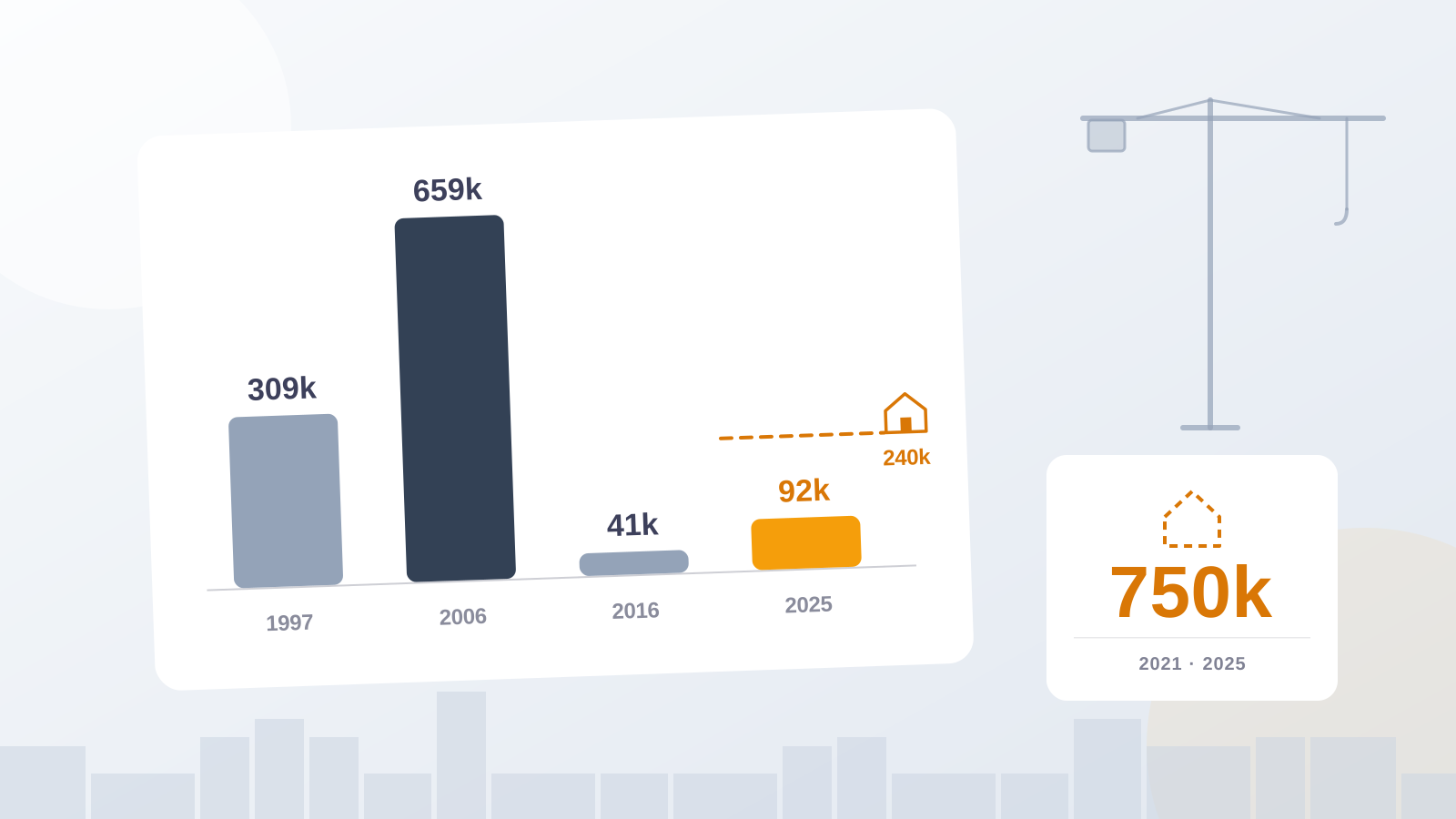
In 2006 Spain completed 658,510 homes, according to the Ministry of Public Works series. Today it completes between 90,000 and 100,000 market-rate homes a year, a figure the Banco de España describes as stagnant.
Demand hasn’t stopped. Spain reached 49,801,559 residents on 1 July 2026, according to the INE. In the last year, 240,000 new households were formed and 92,000 homes were built. The Banco de España puts the accumulated shortfall at 750,000 homes between 2021 and 2025, and expects it to stay close to a million in 2028.
Spain has been here before. Between 2000 and 2008 the population grew by about 5.6 million people, mostly through immigration. Back then the country completed between 400,000 and 650,000 homes a year. Today the population is growing again at a pace that comes close, about 500,000 people a year since 2021 according to CaixaBank Research. And Spain builds a sixth as much.
Relative to the number of households, Spain’s shortfall is 3.7%. In Germany it’s 1.5%. France is in balance.
Why Spain doesn’t build
It isn’t for lack of projects. Permits for market-rate housing reached 136,000 in 2025, the highest since 2008. The bottleneck sits before and after the paperwork.
Before, in the land. Getting from a plot of land to a building site takes about 15 years on average, and more than 20 when there are court challenges, according to the developer associations APCEspaña and ASPRIMA. A building permit takes about six months in a small, well-run town and up to 24 in a big city like Madrid. Madrid Nuevo Norte, in Chamartín, has been on the table for more than 30 years.
The reform of Spain’s Land Law, designed to make urban plans harder to annul in court, was withdrawn on 23 May 2024, hours before the vote. The government’s left-wing partners saw it as an open door to speculation. Junts saw it as an invasion of regional powers. The PP’s support was unclear. Everyone agrees land is the problem, and the one national law meant to fix it died somewhere between them.
After, on the building site. The 2008 crash took half the industry with it: construction lost about 1.4 million jobs between 2008 and 2012, a drop of 52.9%. Bank lending to developers and builders was above €150 billion before 2008. In 2024 it was around €25 billion.
And protected, below-market housing nearly disappeared. Between 1991 and 2008 Spain completed close to 60,000 of these homes a year on average. In 2025 it completed 11,104.
Today’s shortfall didn’t appear overnight. It’s the bill for the decade after 2008, when Spain almost stopped building. In 2015 and 2016 fewer than 50,000 homes were completed.
Where the homes are
If Spain isn’t building, the question is who holds the homes that already exist. And here both sides are partly right.
According to the Banco de España, more than 90% of homes rented at market prices belong to private individuals, and companies own about 8%. Individuals with more than ten homes hold no more than 7% of the rental stock. Nationally, it’s a small-landlord market.
But concentration is rising. Using land registry data, the housing charity Provivienda estimates that owners with three or more homes went from 22.4% of owners in 2006 to 29.4% in 2024. And some cities look very different. In Barcelona, 1.2% of landlords, those with more than 15 flats let out, hold 24.1% of rented homes.
The debate runs on Barcelona’s data. The laws apply to all of Spain.
The funds
The big funds came in with the crash. In 2013, Madrid’s municipal housing company sold 1,860 protected homes to Fidere, a Blackstone subsidiary. By 2016, Blackstone valued that portfolio at more than €660 million.
Institutional money is moving again today, but not into long-term renting. In the first nine months of 2024, investment in residential rental fell by about 65% according to JLL, while investors had committed about €2.6 billion to 23,200 flexible-living units according to Colliers. The industry itself says the Housing Law is pushing it that way. Blackstone has put Fidere up for sale and is weighing an exit from Testa in 2027.
Regulation didn’t push the funds out of housing. It pushed them out of the regulated part.
The public housing that expired
Spain isn’t a country that never built protected housing. It’s a country where protected housing expires. For decades it was built with a use-by date: after a period set by each region, it loses its protected status and joins the open market. Of the roughly 1.5 million protected homes built since 1991, Spain will have lost about half, according to the Civio Foundation.
The result is that social rental housing makes up 3.3% of Spain’s primary homes, against an EU average of 8%.
Tourist flats, seasonal lets and empty homes
The INE counted 341,001 tourist homes in May 2026, 10.7% fewer than a year earlier. The Banco de España estimates they’re equivalent to about 10% of the residential rental market. Their effect is real but local. The most cited study, on Barcelona, estimates that Airbnb raised rents by 1.9% on average and by about 7% in the busiest neighbourhoods.
Seasonal lets matter most where there are caps. According to the Banco de España, they make up around 13% of rental listings in Spain and more than 40% in Barcelona.
What about empty homes? The 2021 census counted 3.8 million. But 45% of them are in towns of fewer than 10,000 people. In the city of Madrid, only 6.3% of homes are empty.
The same goes for foreign buyers. They made 13.8% of purchases in Spain in 2025, but 43% in Alicante and 33% in Málaga. It’s a coastal story, not a Madrid one.
None of these factors explains a national rise on its own. They all squeeze hardest where there’s already no room.
The rules set prices too
Catalonia has capped rents since March 2024. According to an analysis by FEDEA, between the first quarter of 2024 and the last quarter of 2025 rents rose 5.7% in Catalonia, against 8.5% in Madrid and 10.8% across Spain. Prices rose less.
Over the same period, rental listings fell 20.5% in Catalonia and rose 3.9% in Madrid. At the end of 2025, each listing in Barcelona drew 462 enquiries. In Madrid, 103.
Cheaper for those who already have a lease. A lottery for those looking.
The Banco de España adds another piece. When rent rises on existing leases are capped, landlords front-load the increase when they sign a new one. Whoever moves in pays for it.
Then there’s the uncertainty. On 29 September the government approved two housing decrees. On 2 October Congress voted them down. On 6 October the government approved them again. There’s a general election on 29 November. It’s hard to price a five-year lease when the rules last a week. Meanwhile, long-term rental listings on idealista fell from 902,664 in 2018 to 510,091 in 2025.
Spain has run this experiment before
The Bugallal decree of 1920 froze rents and forced landlords to renew leases. It was meant to be temporary. It survived the Republic, the Civil War and Franco, and the 1964 text locked in the forced extension: tenants could stay indefinitely and pass the lease to a spouse or children, at a rent that barely moved.
At the same time, the regime pushed everyone towards buying. Housing minister José Luis Arrese summed it up in a line still quoted today: a society of owners, not proletarians.
The census tells the story. In 1950, only 6.4% of homes in Madrid and 5.1% in Barcelona were lived in by their owners. More than nine in ten homes didn’t belong to the people living in them. By 2001, home ownership had reached 78.6% in Madrid and 68.2% in Barcelona. With rents frozen, letting stopped being a business, and landlords sold up flat by flat.
In 1985, the Boyer decree freed up new contracts. And the pendulum swung too far. The preamble to Spain’s 1994 Urban Leases Act admits it: liberalisation stopped renting from shrinking further, but created “una enorme inestabilidad” (huge instability), very short contracts and “un movimiento de incremento de las rentas muy significativo” (a very significant rise in rents). In 1994 only 18% of homes were rented, and half of all leases predated 1964, at rents the law itself called “ineconómicas”, uneconomic.
It took 74 years to find a middle ground.
Portugal went through much the same. In Lisbon and Porto, rents stayed frozen for most of the 20th century. In 1990 only new contracts were freed up, and older ones were still frozen in 2018.
What happened elsewhere
Berlin froze rents in 2020. Regulated rents slowed, but the supply of flats to rent fell by up to 60% and unregulated rents rose faster than in other German cities, according to the ifo Institute. Germany’s Constitutional Court struck the law down in April 2021.
The Netherlands extended rent regulation in July 2024. In the quarter before it took effect, rental supply on the Pararius portal had already fallen 32.8% year on year, the price per square metre had risen 9.9%, and more landlords were selling.
Stockholm has controlled rents for decades. At the end of 2025, 894,592 people were registered on its municipal waiting list, which allocated 20,861 flats that year. The average wait was nine years. In the inner city, 21.
The places where rents really came down did something else. In Vienna, 42% of homes are owned by the city or by non-profit housing associations, and the average rent in 2023 was €10.5 per square metre, against €33.8 in inner London. Auckland rezoned three-quarters of its residential land in 2016 to allow denser building. Six years later, rents were about 28% lower than they would have been without the reform, according to the University of Auckland.
Some built public housing for a century. Others freed up land. None of them did it with caps alone.
So who sets the price?
Scarcity. A flat in Barcelona rents for a lot because hundreds of people are asking about it, not because its owner has one flat or twenty.
That doesn’t make anyone innocent. Every landlord, big or small, puts a price on risk. If they don’t know what rules their lease will be under in three months, or who they’re renting to, they ask for more, switch to seasonal lets, or sell.
New housing takes 15 years to arrive. Until then, the only quick lever is the housing that already exists: making long-term renting a calm decision again. Rules that outlast a parliament. Unpaid rent resolved in a reasonable time. And trust between both sides before anyone signs.
At Abitamo we work on that last part: letting landlords check a tenant’s ability to pay, and letting tenants prove it. That doesn’t build a single home. But every flat that goes back to long-term renting because its owner feels safe is one more home on the market.
What would it take for you to sign a long lease without fear, as a landlord or as a tenant?